Tuesday, March 04, 2014

Revisiting the Financial Crisis: Meeting of the Federal Open Market Committee on September 16, 2008 Part 2

This is part 2 of the my thoughts on the Federal Open Market Committee on September 16, 2008. You can read part 1 here. This meeting of the FOMC took place after Lehman Brothers filed for bankruptcy.

William C. Dudley had a laughably bad read of how the financial industry would react to the Federal Reserve not lowing the interest federal funds rates. This is the interest rate set by the Federal Reserve for banks lending to each other. Banks were desperate for credit after the Lehman Brothers announcement. Dudley thought banks would support the Fed not lowering the federal funds rates.

MR. DUDLEY. Well, I think the market participants would gain some comfort to the extent that the Federal Reserve as an institution indicates concern about what’s going on in the financial markets. But in some ways the Desk has already signaled that concern by its intervention, so I’m not sure that additional indications are needed. But in the language you might want to indicate to market participants that, if things were to materially worsen in the financial markets, the Committee might revisit the issue of where the federal funds rate should be.

Dennis P. Lockhart, the President of the Federal Reserve Bank of Atlanta, believed that the economy would start to recover in 2009.

With that as prologue, let me make just a couple of comments on regional soundings from the last couple of weeks. Anecdotal reports from the Sixth District support the view that the economy is quite weak but not deteriorating markedly. The CFO of a large retailer of housing-related goods said that they think they see a bottom forming. I am also starting to hear some reports that housing markets feel as though they are beginning to stabilize; but, really, it is a little too early to say that a bottom has formed in any of our housing markets. My overall sense from District contacts and our surveys is of an economy that is quite weak, with no clear trend evident.

Turning to the national outlook, like most forecasts, my view on the likely path for the economy has not changed materially since our August meeting. I see nothing in the data and hear nothing from District reports that alters my views that the second half will be very weak. I expect this weak period to be followed by a slow recovery gathering in 2009, but the foundation of a recovery starting around year-end or early 2009 may be far from solid. The contraction of credit availability that is confirmed by both surveys and anecdotal evidence could deepen as financial institutions face tight liquidity and difficulty recapitalizing. A protracted credit crunch would likely operate as a substantial drag on the economy.

The economic stimulus package, signed into law by President Barack Obama, helped keep a recession from turning into a depression. We can see that the unemployment rate ticked up after the September meeting of the FOMC.

Lockhart was also wrong in his prediction of the federal funds rate.

My view of the appropriate policy path is consistent with the Greenbook—that the fed funds rate target will remain stable at or close to the current level for several months going into 2009. My preference is to hold the fed funds rate at the current level of 2 percent. Among the reasons is that a ¼ percentage point drop, as suggested by alternative A, is really not clearly called for by a changed outlook for the real economy. Inflation risks are still in play, and I think we should give credit markets more time to digest events and sort out rate relationships.

The Federal Reserve changed course and have kept federal fund rates near zero percent. From the Federal Reserve website.

To support continued progress toward maximum employment and price stability, the Federal Open Market Committee expects that a highly accommodative stance of monetary policy will remain appropriate for a considerable time after the economic recovery strengthens. In its December 2013 statement, the Committee reaffirmed its expectation that the current exceptionally low target range for the federal funds rate of 0 to 1/4 percent will be appropriate at least as long as the unemployment rate remains above 6-1/2 percent, inflation between one and two years ahead is projected to be no more than half a percentage point above the Committee's 2 percent longer-run goal, and longer-term inflation expectations continue to be well anchored. In addition, at its December 2013 meeting, the Committee indicated that, based on its assessment of measures of labor market conditions, indicators of inflation pressures and inflation expectations, and readings on financial developments, it will likely be appropriate to maintain the current target range for the federal funds rate well past the time that the unemployment rate declines below 6-1/2 percent, especially if projected inflation continues to run below the Committee's 2 percent longer-run goal.

The Federal Reserve has kept fund rates near zero percent to keep credit moving between the banks. The fourth quarter of the 2008 was projected to have low GDP. Unemployment has showed signs of increasing. The housing bubble had popped. Banks were starting to go into panic mode after the Lehman Brothers bankruptcy. What was Lockhart thinking that the 2 percent federal fund rate could be maintained?

Future Federal Reserve chair Janet Yellen was correct in her projection unemployment and housing construction numbers would dip.

Recent data also suggest that labor markets are weakening across the board—a development that will cast a pall on household income and spending. The interaction of higher unemployment with the housing and financial markets raises the potential for even worse news—namely, an intensification of the adverse feedback loop we have long worried about and are now experiencing. Indeed, delinquencies have risen substantially across the spectrum of consumer loans, and credit availability continues to decline. One ray of hope is that the changes at Fannie and Freddie have caused a notable drop in mortgage rates. Another is that the decline in home prices has become somewhat less steep, and we have seen an outright improvement in home inventories relative to sales. But my contacts are very pessimistic about the prospects for nonresidential construction. They note that construction is continuing on projects in the pipeline with committed funding, but new projects are all but impossible to finance.

Unfortunately, Yellen mistakenly back keeping the federal fund rates at 2 percent.

What is fascinating is the FOMC was obsessed with inflation during the meeting. Inflation turned out to be the least of the America's economic problems in 2009. Inflation actually dropped to 1.1 percent in November of 2008 In December the rate was 0.1 percent. Inflation stayed below 3 percent in 2009.

Meeting of the Federal Open Market Committee on September 16, 2008 by Michael Robert Hussey

Labels: , , , ,

Monday, January 06, 2014

Rubio Votes Against Janet Yellen

Sen. Marco Rubio gives an absolutely nonsensical reason for voting against the confirmation of Janet Yellen as the Federal Reserve chair.

“While Dr. Yellen is an accomplished individual, I will be voting against her nomination to chair the Fed because of her role as a lead architect in authoring monetary policies that threaten the short and long-term prospects of strong economic growth and job creation. Altogether, she has championed policies that have diminished people’s purchasing power by weakening the dollar, made long-term savings less attractive by diminishing returns on this important behavior, and put the U.S. economy at increased risk of higher inflation and another future boom-bust."

There is no immediate risk of inflation. If Rubio knew anything about economics or didn't have contempt for the intelligence of his constituents then he wouldn't babble such nonsense. Inflation is caused by the increase of the price of goods. According to the U.S. Bureau of Labor Statistics numbers, inflation has actually been going down since the January of 2012. There has been no major threat of 70s level inflation during the Bush or Obama years. There certainly wasn't high levels of inflation during the Clinton years.

Where does Rubio get his information that Yellen's monitory policies have put the U.S. at risk of inflation. Does Rubio even know that there is always some level of inflation. Prices of goods always increase. Rubio voted against the first woman Federal Reserve chair over a made up issue.

Even Rubio admits Yellen's resume is impressive. Wall Street preferred Yellen over Lawrence Summers. Wall Street likes quantitative easing.

This isn't about inflation, Yellen's credentials or Wall Street. The only logical reason Rubio voted against Yellen is she is an Obama nominee.

Labels: , , ,

Tuesday, December 03, 2013

Wages Aren't Keeping Up With Cost of Living In Florida

A report released by the Alliance for a Just Society finds that current wages do not keep up with the cost of living.

The National Job Gap: 7 Job-Seekers for Every Job that Pays Above the Low-Wage Threshold: For every projected job opening above a low-wage threshold of $15 an hour, there were 7 job-seekers in 2012.

Nearly 18 Million Job-Seekers Out of Luck: With 20.8 million job-seekers and 2.9 million projected job openings that pay better than $15 an hour in 2012, there were 17.9 million more job-seekers than jobs that pay above the low-wage threshold.

An Increasing Share of Low-Wage Jobs since End of Great Recession: In terms of actual employment rather than projected openings, the share of U.S. jobs that pay below the $15 an hour low-wage threshold increased from 36.55% in 2009 to 39.45% in 2012. There were 51.4 million low-wage jobs in 2012.

“Jobless Recovery” Masks Loss of Higher-Wage Jobs, Replacement with Low-Wage Jobs: The number of jobs in occupational categories with median wages above $15 an hour dropped by 4 million from 2009 to 2012, masked by an increase of 3.6 million jobs with median wages below $15 an hour.

Sen. Elizabeth Warren pointed out that the minimum wage hasn't kept up with productivity. If the minimum wage did keep up with productivity the minimum wage would be $22.00 hr.

Labels: , , , ,

Thursday, October 03, 2013

IMF Scared Congress May Cause Another Crash

International Monetary Fund Managing Director Christine Lagarde is warning Congress that the debt ceiling must be raised. Immediately.

“The government shutdown is bad enough, but failure to raise the debt ceiling would be far worse, and could very seriously damage not only the U.S. economy, but the entire global economy,” Lagarde said in a speech in Washington to students at George Washington University. “So it is ‘mission-critical’ that this be resolved as soon as possible.”

The Treasury Department is worried that not raising the debt ceiling would cause an international credit freeze.

The United States has never defaulted on its obligations, and the U. S. dollar and Treasury securities are at the center of the international financial system. A default would be unprecedented and has the potential to be catastrophic: credit markets could freeze, the value of the dollar could plummet, U.S. interest rates could skyrocket, the negative spillovers could reverberate around the world, and there might be a financial crisis and recession that could echo the events of 2008 or worse.

The last time there was an international credit freeze was when Lehman Brothers declared bankruptcy. The result was the worst economic crisis since the Great Depression. The TARP program was created to get money moving in the banking system again. Republicans in Congress may start another crash if they don't give President Barack Obama a clean CR bill to sign.

Labels: , ,

Sunday, September 29, 2013

Alex Pareene's First and Last Appearance on CNBC

It is hard to believe that CNBC let Alex Pareene of Salon.com to come on. The result was Pareene hammered Jamie Dimon and JP Morgan.

Maria Bartiromo: Alex, to you first. Legal problems aside, JP Morgan remains one of the best, if not the best performing major bank in the world today. You believe the leader of that bank should step down?

Alex Pareene: I think that any time you’re looking at the greatest fine in the history of Wall Street regulation, it’s really worth asking should this guy stay in his job. In any other industry — I can’t think of another industry. If you managed a restaurant, and it got the biggest health department fine in the history of restaurants, no one would say “Yeah, but the restaurant’s making a lot of money. There’s only a little bit of poison in the food.”

Maria Bartiromo and Duff McDonald come to Dimon's rescue. McDonald goes as far as to say Dimon has a "great track record." Former IMF economist Simon Johnson would disagree. Johnson has called Dimon "the most dangerous man in America."

1. Big companies need big banks, operating across borders, with large balance sheets and the ability to execute a wide variety of transactions. This is simply not true – if we are discussing banking at the current and future proposed scale of JP Morgan Chase. We go through this in detail in 13 Bankers – in fact, refuting this point in detail, with all the evidence on the table, was a major motivation for writing the book. There is simply no evidence – and I mean absolutely none – that society gains from banks having a balance sheet larger than $100 billion. (JP Morgan Chase is roughly a $2 trillion bank, on its way to $3 trillion.)

2. The US banking system is not particularly concentrated relative to other OECD countries. This is true – although the degree of concentration in the US has increased dramatically over the past 15 years (again, details in 13 Bankers) and in key products, such as credit cards and mortgages, it is now high. But in any case, the comparison with other countries doesn’t help Mr. Dimon at all – because most other countries are struggling with the consequences of banks that became too large relative to their economies (e.g., in Europe; see Ireland as just one illustrative example).

3. Canada did fine during 2008-09 despite having a relatively concentrated financial system. Mr. Dimon would obviously like to move in the Canadian direction – and top people in the White House are also very much tempted. This is frightening. Not only does it represent a complete misunderstanding of the government guarantees behind banking in Canada (which we have clarified here recently), but this proposal – at its heart – would allow, in the US context, even more complete state capture than what we have observed under the stewardship of Hank Paulson and Tim Geithner. Place this question in the context of American history (as we do in Chapter 1 of 13 Bankers): If the US had just five banks left standing, would their political power and ideological sway be greater or less than it is today?

Labels: , , , , , , ,

Monday, July 29, 2013

Quote of the Day

""The policies he promoted as Treasury Secretary and in his subsequent writings led to the economic disaster that we now face." Dean Baker, economist, on Lawrence Summers.

Baker correctly predicted there there was a housing bubble in 2002. Banks continued to create risky mortgage-backed securities.

Summers pushed for the repeal of Glass-Steagall Act. This allowed investment banks to merge with commercial banks. The result was banks making bad investments with people's life savings. This nearly caused the banking system to crash.

I think we can safely say that Baker is a smarter economist than Summers.

Labels: , ,

Thursday, July 25, 2013

Group of Senate Democrats Against Larry Summers at the Federal Reserve

Talking Points Memo report that Senate Democrats have sent a letter to President Barack Obama. These mostly undisclosed Democrats are against Lawrence Summers being appointed as chairman of the Federal Reserve.

"There's a lot of concern among a lot of Democrats about an appointment of Larry Summers to that long-term position as Fed chairman," Sen. Tom Harkin (D-IA), who signed the letter, told the Journal. "He was one of the architects of getting rid of Glass-Steagall, of getting rid of other regulations. There's real concern about his economic views not really being in line with Obama's views."

Sens. Dianne Feinstein (D-CA), Dick Durbin (D-IL) and Angus King (I-ME) are also confirmed to have signed the letter.

These groups of Democrats want Obama to appoint Janet Yellen as chair of the Federal Reserve. Sheila Bair, former chair of the FDIC, makes the case to appoint Yellen. Bair notes Yellen's resume and knocks Summers role in deregulation.

That could change if the heir apparent to succeed Ben Bernanke as Chair of the Federal Reserve Board, Janet Yellen, is nominated for the job by President Obama. Certainly, there is no better qualified candidate to fill Bernanke's shoes when he steps down in January. A noted economist, Yellen headed the Council of Economic Advisors for two years; led the San Francisco Federal Reserve Bank for six years; and has served ably as Bernanke's Vice Chairman since 2010. Unlike Larry Summers, Tim Geithner, and Bob Rubin -- minions frequently mentioned in the financial press as potential Bernanke successors -- she was not part of the deregulatory cabal that got us into the 2008 financial crisis. In fact, she had a solid record as a bank regulator at the San Francisco Fed and was one of the few in the Fed system to sound the alarm on the risks of subprime mortgages in 2007.

Bair and Ezra Klein report there currently a whisper campaign against Yellen's nomination. The question is who is behind the whisper campaign?

Labels: , , , , , , , , ,

Sunday, June 30, 2013

Income Inequality

 photo 2_zps43af28f2.jpg

The Hamilton Project has done a study on how income inequality social mobility and education. As you can see by the chart; Americans making less aren't moving above their economic status. In America the Haves have more and the have nots are getting poorer.

Figure 1 illustrates the diverging fortunes of children based on their family’s income, as measured by the U.S. Census Bureau. Children in families at the top of the income distribution have experienced sizable gains in their families’ incomes and resources since 1975. Children living in the top 5 percent of families, for instance, have seen a doubling of their families’ incomes. But such gains have been more modest for children in the middle of the distribution, and children living in lower-income families have experienced outright declines in incomes. In fact, in 2011 the bottom 35 percent of children lived in families with lower reported incomes than comparable children thirty-six years earlier.

The Hamilton Project compared a college education to other investments. The findings show it makes financial sense to further the education of young people.

 photo 11_zpsa04c3f07.jpg

What will hurt the future of education America's young people is the increase in student loan debt.

Over the past decade, the volume and frequency of student loans have increased significantly. The share of twenty-five-year-olds with student debt has risen by about 15 percentage points since 2004, and the amount of student debt incurred by those under the age of thirty has more than doubled (Lee 2013).

Despite these increases, the majority of students appear to borrow prudently. About 90 percent have loan balances less than $50,000, and 40 percent have balances under $10,000 (Fry 2012). Given that a college graduate can expect to earn, on average, about $30,000 more per year than a high school graduate over the course of his or her life, the returns to college appear to warrant the cost of student loans for most students.

House Republicans wanted to raise student loan rates from 3.4 to 8.5 and let rates fluctuate with increases in Tresury notes. Democrats wanted to wanted to lock in rates at 3.4 percent for another two years. House Speaker recessed without bringing up student loan rates. Boehner spent the week failing to pass the Farm bill.

We have one of the two major political parties helping cause income inequality by making college education too expensive for students.

Labels: , , ,

Thursday, May 23, 2013

To Big to Prosecute is A Myth

Attorney General Eric Holder made news earlier this year when he told the Senate Judiciary Committee that the big banks are too big too to prosecute.

I am concerned that the size of some of these institutions becomes so large that it does become difficult for us to prosecute them when we are hit with indications that if you do prosecute, if you do bring a criminal charge, it will have a negative impact on the national economy, perhaps even the world economy, and I think that is a function of the fact that some of these institutions have become too large.

The recent House financial services committee hearing revealed that the Department of Justice based this assumption on no empirical evidence.

The U.S. Department of Justice appears to have neither conducted nor received any analyses that would show whether criminal charges against large financial institutions would harm the economy, potentially undermining a key DOJ argument for why the world’s biggest banks have escaped indictment.

Testimony by a top Justice official and fresh documents made public on Wednesday during a House financial services committee hearing revealed that financial regulators and the Treasury Department did not provide warnings to prosecutors weighing the economic consequences or fallout in the financial system of criminal indictments against large financial groups. DOJ also could find no records that would substantiate its previous claims that it weighed potentially negative economic or financial impacts when considering criminal charges, said Mythili Raman, acting assistant attorney general for the criminal division.

This is video Sen. Elizabeth Warren during her first Banking Committee hearing. Warren questioned financial regulators on when was the last time they took a major bank to trial. The answer they all the regulators gave is none. This was prior to the recent Senate Judiciary Committee hearing. Warren serves on the

The Obama administration has no interest in prosecuting major financial institutions. The Senate Judiciary Committee reveals that the Justice Department never had studies conducted on what the economic impact would be if major financial institutions were prosecuted. Holder never had the studies done because he never wanted to run the risk of an answer that would be unacceptable to the White House.

Labels: , , , , , ,

Tuesday, April 09, 2013

Shocker: Rick Scott Warming Up to Miami Dolphins Stadium Deal

It should come as no surprise that Gov. Rick Scott is leaning towards supporting the Miami Dolphins stadium deal.

I like the fact that the Dolphins are putting up a lot of [the club's] money up," he said Tuesday, the day after the football team inked an agreement with Miami-Dade County. "I like the fact they're committing to stay. I like the fact that there's a referendum. They're fulfilling those obligations. But I haven't seen the return-on-investment numbers, which of course is the biggest thing."

Study after study have found that sports stadiums do not have a major positive economic impact for local communities. A study by economists Brad Humphreys and Dennis Coates for the libertarian-leaning Cato Institute found the financial benefits of sports stadiums overrated.

Our conclusion, and that of nearly all academic economists studying the issue, is that professional sports generally have little, if any, positive effect on a city's economy," Humphreys and Coates wrote in a report issued last month by the Cato Institute in Washington, D.C.; The institute commissioned the professors to study the economic impact of a deal proposed by Anthony Williams, the mayor of Washington, D.C.; under terms of the agreement, Major League Baseball would move the Montreal Expos to the nation's capital in exchange for a new, city-built ballpark.

Economist Dean Baim found that taxpayers loss money on sports stadiums. The reason is simple. Taxpayers pay for the construction and upkeep of the sports venues. The owners of the sports franchises keep the profits. Cities do not get a return on their investment. Would you give money to let someone start a business and then let that business owner keep the profits? That is exactly the kind of deals elected officials negotiates with sports franchises.

Scott made the statement that the Miami Dolphins will put up money to pay for the stadium. Tampa Bay Buccaneers owner Malcolm Glazer promised to pay have the cost of the construction of Raymond James Stadium. Glazer later reneged on that promise. Don't count on Dolphins owner Stephen Ross to put up a penny for a new stadium.

Labels: , , , ,

Wednesday, April 03, 2013

David Stockman: Economic Anarchist

I wonder how much of the comtempt of the federal Reserve from Republican economic policymakers is rooted in the writings of Milton Friedman. Case in point is David Stockman.

A recurring theme of Stockman’s work is that it is precisely these efforts that have sown the seeds for all that ails the economy. He writes in the Times: “As the federal government and its central-bank sidekick, the Fed, have groped for one goal after another — smoothing out the business cycle, minimizing inflation and unemployment at the same time, rolling out a giant social insurance blanket, promoting homeownership, subsidizing medical care, propping up old industries (agriculture, automobiles) and fostering new ones (“clean” energy, biotechnology) and, above all, bailing out Wall Street — they have now succumbed to overload, overreach and outside capture by powerful interests.”

Friedman was highly critical of the Federal Reserve allow the dollar to deflate and not acting fast enough to stop the crash of 1929.

The first bank runs started in 1930. Banks did not have enough revenue to cover businesses and customers withdrawing money. Friedman is correct about the Federal Reserve acting too slow.

Friedman made it popular for conservatives to hate the Federal Reserve. However, Stockman argues that Friedman is wrong. Friedman rightly stated that the Federal Reserves not giving the banks a cash injection in 1929 was wrong. Stockman argues against the selling of Treasury bonds.

“During the four decades since the gold window was closed – the rules of the game have been profoundly altered. Specifically, under Professor Friedman’s contraption of floating paper money, foreigners may accumulate dollar claims or exchange them for other paper monies. But there can never be a drain on US monetary reserves because dollar claims are not convertible. This infernal regime of fiat dollars, therefore, has had numerous lamentable consequences but among the worst is that it has facilitated open-ended monetization of US government debt.” ibid.

Does Stockman actually want to go back to the gold standard? The man has lost his mind.

Hank Paulson, Tim Geithner and Ben Bernanke allowed Lehman Brothers to fall. The three even urged Lehman Brothers to file for bankruptcy. The result was an international economic crisis. International financial institutions froze credit after Lehman Brothers fell. Paulson went to Congress to get TARP passed and bailout AIG and the too big to fail banks. Stockman would have let AIG and the banks fail. The result would have been an economic crisis worse than the Great Depression. I am no fan of the way Paulson, Bernanke and Geithner handled the 2008 financial crisis. However, what Stockman is advocating is anarchy.

Labels: , , , , , ,

Sunday, January 06, 2013

Summers & Krugman On Canadian Panel


Lawrence Summers and Paul Krugman were on were in Canada in 2011 to talk about the slow recovery of the United States economy. Summers was slightly more optimistic thanKrugman about the recovery. Both Summers and Krugman agree that the recovery has been horrible.

Labels: , ,

Monday, December 03, 2012

Chart on Wages vs. Corporate Profits

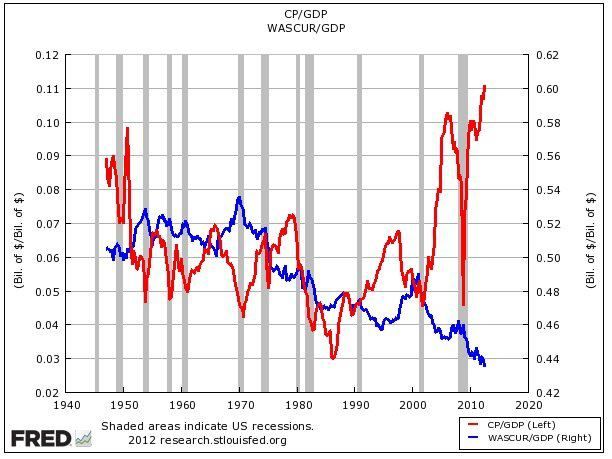
This is the biggest failure of President Obama. The red line represents corporate profits. The blue line is wages. The corporate world has done well after the 2008 Wall Street crash. Wages have not kept up with cost of living expenses. Obama spent much of his first-term with an addictive need to be centrist. Sec. of Treasury Tim Geithner viewed aid for the middle class with contempt.

The economic team went round and round. Geithner would hold his views close, but occasionally he would get frustrated. Once, as [then chairwoman of the Council of Economic Advisers Christina] Romer pressed for more stimulus spending, Geithner snapped. Stimulus, he told Romer, was “sugar,” and its effect was fleeting. The administration, he urged, needed to focus on long-term economic growth, and the first step was reining in the debt.

Austerity measures would only strengthen a recession during an economic downturn. Economists Carmen M. Reinhart & Kenneth S. Rogoff predicted the economic crisis and that policymakers would hurt the recovery by implementing austerity policies. Geithner is too stupid to be Treasury Secretary.

Labels: , , ,

Sunday, October 21, 2012

Glenn Hubbard Must Not Become Treasury Secretary

Glenn Hubbard is a political hack of epic proportions. It would be a disaster for America if Mitt Romney won the presidency and appointed Hubbard as Treasury Secretary or chairman of the Federal Reserve. Hubbard has argued for the Federal Reserve raising interest rates during the the economic downturn.

Hubbard served as chairman of the Council of Economic Advisers during the beginning of the Bush administration. Former Treasury Sec. Paul O'Neill told Hubbard that the surplus needed to be used to shore up entitlements.O'Neill also warned that the surplus would disappear with the tax cuts Hubbard was drafting. Hubbard has convenient amnesia about the conversations O'Neill had with him.

HUBBARD: "I don’t ever recall Paul O’Neill sharing that observation at the time. I will say that early on in the Bush campaign for president, while he was still governor, Social Security reform was an issue that came up in any discussion of budget surpluses. However, it was Governor Bush’s conclusion that, politically, using the surplus for Social Security was not likely to happen."

O'Neill told Ron Suskind of the level of Hubbard's hackery in the book "The Price of Loyalty." Hubbard pushed for tax cuts after the September 11th attacks shook the financial markets and the likelyhood of America paying for war in Afghanistan.

"I believe that any large tax cut proposal that is not a product of consultation with Democratic leadership will begin to unravel the fragile trust and bipartisanship we are currently experiencing," Weinberger wrote. After opposition from O'Neill, Greenspan and former Treasury Secretary Bob Rubin to acting before facts about post-Sept. 11 economic effects became clear, a cut of $48 billion was passed six months later. But an internal administration debate about whether the Sept. 11 attacks should be used to carry forward a partisan agenda had begun.

Hubbard is an extremely unpleasant man who wishes to hide his ties to the financial sector. This scene from the movie Inside Job should give people pause about Hubbard serving again in government.

Hubbard worked as an adviser for Goldman Sachs. Hubbard co-wrote a study with then Goldman Sachs economist William C. Dudley that urged for selling toxic derivatives for mortgages.

“The capital markets have helped facilitate a major transformation of the U.S. mortgage financing system over the past 25 years. … The result has been a dramatic decline in the cyclical volatility of housing activity.”

The short answer is Hubbard and Dudley were encouraging Goldman Sachs to sell garbage mortgage-backed securities to their investors and then bet on mortgages to go bad. The investors lose money, but Goldman Sachs makes a killing.

An example of how big of economic hacks are Hubbard and Dudley. The stupidity of this would be laughable, if it wasn't for the 2008 crash.

“This use of derivatives leads to improved economic performance,” they wrote, insisting, “The capital markets have also acted to reduce the volatility of the economy. Recessions are less frequent and milder when they occur.”

Is there anything this man hasn't been wrong on? Hubbard is now going around claiming Mitt Romney will explain the tax base and create 12 million jobs in 4 years. Hubbard and the Romney campaign are adding the numbers of jobs from three studies to come to the magic number of 12 million. One study says that if China starts honoring U.S. patents it would create two million jobs. Good luck getting China to do that.

If Romney wins, Democrats need to block Hubbard from ever getting confirmed to head Treasury or the Federal Reserve. There isn't a more greedy, fantasy-based and incompetent economist out there. Hubbard is unfit to serve in government.

Labels: , , , ,

Monday, March 05, 2012

Trickle Down Economics Redux

Former Reagan administration budget directer David Stockman said that trickle down economics was designed to create deficits, that would justify cutting entitlement programs. The Reagan administration never expected trickle down economics to increase economic growth. Stockman also notes that trickle down economics was renamed supply-side economics because voters would not believe that they would somehow benefit from the wealthy getting tax cuts.

Gregory Mankiw served as Chairman of Council of Economic Advisers, under President George W. Bush. Paul Krugman noted that Mankiw has little respect for the Reagan economic team creating supply-side economics.


Consider Mr. Mankiw, in particular. Modern Republicans detest Keyes; Mr. Mankiw is the editor of a collection of papers titled "New Keynesian Economics." In an early edition of his best-selling textbook, he dismissed supply-side economics - the doctrine embraced by the sainted Ronald Reagan - as the creation of "charlatans and cranks." And, in 2009, he called for higher inflation as a solution to the economic crisis, a position anathema to Republicans like Paul Ryan, the chairman of the House Budget Committee, who warn ominously about the evil of "debasing: our currency.


Even Republican economists admit that supply-side economics is bullshit. Remember that the next time you hear Gov. Rick Scott and GOP presidential candidates talk about how tax cuts for the rich will magically create jobs for the middle class.

Labels: , , ,

Monday, August 29, 2011

Rick Perry Doesn't Care About America Paying Its Debts

The Rick Perry campaign has been hysterically trying to deal with the blowback of the book "Fed Up!" It is bad enough that Perry had Newt Gingrich write the forward. Ray Sullivan, communications director, of the Perry campaign told The Wall Street Journal that Perry views on Social Security in "Fed Up!" are "a look back, not a path forward." Translation: the Perry campaign is saying that the views in a book published 9 months ago don't express the current views of the governor. Apparently, Perry hasn't received the memo from his own campaign.

Perry told The Daily Beast that Medicare is unconstitutional and Social Security is a Ponzi scheme. Perry made the same statement again about Social Security on a recent campaign stop.


"It is a Ponzi scheme for these young people," Perry said in Iowa, mimicking his pre-presidential campaign language on the subject of Social Security.

"The idea that they're working and paying into Social Security today, that the current program is going to be there for them, is a lie," Perry added. "It is a monstrous lie on this generation, and we can't do that to them."


Perry is a not ready for prime time player. Eliminating Social Security and Medicare will not play with older Republican voters. A March WSJ/NBC poll showed three out of four Americans do not support cuts in Social Security and Medicare.

Perry's misunderstanding of the Constitution leads to to advocate that America ignores the 14th amendment and not pay its debts. Perry is telling people that the government will not give a return on the Social Security retirement fund they put their money into. Perry doesn't say why. Perry does make clear he doesn't support Social Security. Therefore, he fearmongers.

The "cut, cap and balance" bill failed to pass in the Senate. On August 1, the day before the debt ceiling deadline expires, Perry refuses to support the House & Senate deal that got budget cuts and no tax increases. Perry is saying he would rather let America default. Perry, the so-called fiscal conservative, has no problem with America not paying its bills.

"Cut, cap and balance" illustrates how unserious Perry is about policy. The legislation did not have the 51 Senate votes to become law. How does Perry think "cut, cap and balance" will get 67 votes to become a constitutional amendment? Another problem is the bill is it is not fiscally possible.


Total outlays for any fiscal year shall not exceed 18 percent of the gross domestic product of the United States for the calendar year ending before the beginning of such fiscal year, unless two-thirds of the duly chosen and sworn Members of each House of Congress shall provide by law for a specific amount in excess of such 18 percent by roll call vote.


The fiscal year of 2012 starts on October 1 of 2011. Congress would have to make a budget not knowing what the entire GDP would be. There would be not way to be certain if Congress went over or under the 18 percent of the GDP threshold until after the fiscal year over. It is the equivalent of filing your taxes before the fiscal year started. The fact that Perry would support such an unworkable proposal and advocates that it pass after it was already voted down in the Senate says much about his lack of understanding.

Labels: , , ,

Monday, August 22, 2011

Rick Scott's Let's Get Laid Off Plan

Florida's unemployment rate for July was 10.7 percent. The unemployment rate for June was 10.6 percent. Things are not getting better. Florida lost 22,000 jobs in July. 1,295 of those jobs were state workers laid off by Gov. Rick Scott and the Florida legislature. Many more state and local government jobs will be lost because Republicans have this ideological belief that teachers and clerks get paid more than Goldman Sachs executives.

University of Central Florida economist Sean Snaith told the St. Petersburg Times that unemployment is tied to the lack of leadership in Washington.


"Consumers are suffering from post-traumatic financial stress disorder," Snaith said. "With the recent debt ceiling debacle and all the volatility in financial markets, we're seeing a bit of a flashback to the 2008 financial crisis and the fear it created."

Next month's unemployment report, Snaith warned, could be even worse as both Wall Street and Main Street fret about the threat of a double dip recession. Europe's debt crisis, low consumer confidence, a housing market still seeking a bottom and roller-coaster stock markets are all fueling anxiety.


Meanwhile, Gov. Scott is backpeddling from his promise to create 700,000 jobs on top of the 1,000,000 jobs that were forecasted for the next seven years. You may remember that Scott promised to create 300,000 less then what was forecasted. Scott tells The Orlando Sentinel he doesn't know if his 700,000 job promise is possible.


Scott is now lowering the benchmark he set for himself if he counts every job created toward his 700,000 goal.

"I have no idea — I've never been an economist — what the state would have done," he said, referring to the state's projections. "But I do know that reducing taxes, which kill jobs, getting rid of regulation we don't need that kills jobs, making sure we don't have a bunch of frivolous lawsuits — that's what's going to change the trajectory of the state."


Scott revised his statement. Scott never produced an economic study to say how he would create these jobs. More likely Scott and his campaign team picked 700,000 because it was a nice around number.

Labels: , , , ,

Monday, July 25, 2011

Standard and Poors Places United States on Credit Watch

Standard and Poors have placed several United States financial assets on negative credit watch placement. This means the United States will lose its AAA rating if it doesn't resolve the debt ceiling crisis. It also depends on how the debt ceiling is raised.


However, S&P has said it could move "even if a debt-reduction deal is met and the $14.29 trillion federal debt ceiling is raised. S&P has cited $4 trillion in debt reduction as a figure that would be appropriate for keeping the triple-A rating. S&P has also said it wants a credible agreement, meaning one that has bipartisan support."


Americans could have their homes foreclosed upon, if the Treasury Department cannot make bond payments for Fannie Mae or Freddie Mac. S&P has also place a negative credit watch on subsidized public housing and mortgage-backed securities. The federral government took more bad mortgages to bailout banks. This is many homeowners at potential risk.

Labels: , , ,

Monday, July 18, 2011

Trent Franks: Deficit Peacock


"We know that if we grow this economy, that nothing will do more good toward bringing in additional revenues to government. And that’s not to theory; that’s a historical observation. Even the much-maligned Bush tax cuts brought in an additional $100 billion a year to government coffers. We forget that unless someone is out there producing, there’s no tax revenue. There’s no revenue. There’s no nothing for anyone."

Rep. Trent Franks

Even George W. Bush appointees said to Congress that the tax cuts did not bring in more tax revenue.


Robert Carroll, deputy assistant secretary for tax analysis at the U.S. Treasury Department during Bush’s second term.


“As a matter of principle, we do not think tax cuts pay for themselves.”


Alan D. Viard, a former economist at Council of Economic Advisers during President Bush's first term, said there is no proof that the Bush tax cuts brought in more tax revenue.


"Federal revenue is lower today than it would have been without the tax cuts. There's really no dispute among economists about that," said Alan D. Viard, a former Bush White House economist now at the nonpartisan American Enterprise Institute. "It's logically possible" that a tax cut could spur sufficient economic growth to pay for itself, Viard said. "But there's no evidence that these tax cuts would come anywhere close to that."


Former Treasury Sec. Henry Paulson.


“As a general rule, I do not believe that tax cuts pay for themselves.”


Edward Lazear, former chairman of the chairman of the Council of Economic Advisers, told Senate Budget Committee that the Bush tax cuts lost tax revenue.


“Will the tax cuts pay for themselves? As a general rule, we do not think tax cuts pay for themselves. Certainly, the data presented above do not support this claim. Tax revenues in 2006 appear to have recovered to the level seen at this point in previous business cycles, but this does not make up for the lost revenue during 2003, 2004, and 2005. The tax cuts were a positive step and have contributed to the enhanced economic growth, additional jobs, higher real disposable income, and the low unemployment rates that we currently see today.”


Even Bush's economic team admits that the tax cuts do not increase tax revenue. Simply mathematics dictate that you do not add by subtracting. Franks is another deficit peacock. Franks doesn't care about reducing the deficit. He just wants more tax cuts.

Labels: , , , , ,

Wednesday, June 29, 2011

Geithner Letter to DeMint

Reading Treasury Secretary Tim Geithner's letter to Jim DeMint is horrifying. Geithner has to explain basic economics to DeMint as if he was a child. It is painfully obvious that DeMint is incredibly stupid. Demint believes that the country can run without raising the debt ceiling. DeMint proposes only paying the interest back to banks. Geithner explains that the federal government borrows 40 cents for every dollar. There will will future financial obligations, in terms of loans and budget priorities in legislation that has already been passed.

DeMint believes the Treasury Department runs like his credit card. Just stop using it and everything is okay. If DeMint failed to pay his mortgage and auto insurance, he would be homeless and unable to drive. The federal government would not have enough revenue to fund its military operations in Afghanistan, Libya and Iraq. The fedral government would likely shut down. I wonder how DeMint would feel when he doesn't receive a paycheck.

Geithner explaining DeMint's factual errors to him.

Read more »

Labels: , , ,