Saturday, September 01, 2007

Violence Worse In Iraq

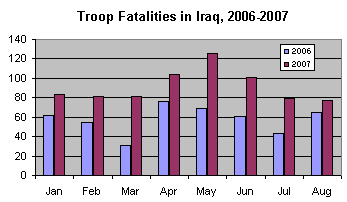

Blog_Troop_Fatalities_2006_2007

U.S. military casualties have gone up during the surge. The Bush administration have repeatedly stated that U.S. military casualties in Baghdad are down. They will not offer statistics to back their assessment. Here are the numbers from Iraq Coalition Casualities Count.

8-2007 81
7-2007 79
6-2007 101
5-2007 126
4-2007 104
3-2007 81
2-2007 81
1-2007 83
12-2006 112
11-2006 70
10-2006 106
9-2006 72
8-2006 65
7-2006 43
6-2006 61
5-2006 69
4-2006 76

"Sectarian violence has sharply decreased in Baghdad," said President Bush. "The momentum is now on our side. The surge is seizing the initiative from the enemy -- and handing it to the Iraqi people."

McClatchy Newspapers reports that civilian casualities increased. Prime Minister Nouri al-Maliki has made no effort to stop Shi'ite militias from killing the Sunnis. The U.S. military's efforts to contain the violence is failing miserably.


The military has been trying to build walls between neighborhoods and around potential bombing targets. But bombings and sectarian violence still take place.


The number of Iraqis killed in attacks changed only marginally in July when compared with December, down seven from 361 to 354, the McClatchy statistics show.


No pattern of improvement is discernible for violence during the five months of the surge. In January, 438 people were killed in the capital in bombings.


General David Petraeus has launched a successful PR campaign to convince lawmakers to keep the surge going. The good General is proving that it's not the merchandise, but the sales pitch.

Labels: , , ,

Sunday, June 17, 2007

Shocking News: Surge Not Working

A Pentagon report states what everyone already knows about the results of the surge and Prime Minister Nouri al-Maliki’s (lack of) leadership. This is coming from an Army Times article.


A Pentagon report released last week concluded that violence in Iraq edged higher during a four-month period between February and May — despite a U.S.-led security push in Baghdad. The report also raised questions about Iraqi Prime Minister Nouri al-Maliki’s ability to fulfill a pledge made in January to prohibit political interference in security operations and to allow no safe havens for sectarian militias.


Al-Maliki told USA Today that "terrorism and militias — especially terrorism — cannot be dealt with only by using tanks, guns and aircraft." This isn't the guy that will play hardball with insurgents and al-Qaeda. This is a different tune than what he was singing when he came into office.


As Prime Minister, al-Maliki has vowed to crack down on militias which he calls "organized armed groups who are acting outside the state and outside the law."


Much has been made of how General Petraeus's September report. In Washington, it has served as an unofficial deadline for continued U.S. involvement in Iraq. Senate Minority Leader Mitch McConnell has admitted as much on Face the Nation.


Senate Republican leader Mitch McConnell of Kentucky said most senators in his party think September is the critical point.


"The proper time to really make a serious evaluation of the direction we ought to head is in September," McConnell said on CBS' "Face the Nation."


It's June and McConnell is very displeased. One can only imagine his mood come September.


``The Iraqi government has been a pretty big disappointment,'' Mitch McConnell, Kentucky Republican and minority leader, said on CBS's ``Face the Nation'' show. ``We've given them an enormous opportunity here, over the last four years, to have a normal country. And our commitment will not be there forever.''


McConnell is openly discussing pulling troops out of Iraq. This man isn't Chuck Hagel. McConnell is a fierce partisan Republican. If he is jumping off the Iraq bandwagon than the White House is in trouble. Bogart and Bergman will always have Paris. Bush will always have Lieberman.

Labels: , , , , ,