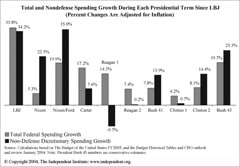
Democrats should use this photo every time Republicans accuse Democrats of being tax and spend liberals. There hasn't been a Republican with a balanced budget since President Eisenhower.
Ezra Klein reports that the federal deficit went down by 37 percent in 2013. The deficit fell to $680 billion. That translates into 4.1 percent of the GDP. In 2012, the deficit was 6.8 percent of GDP. Contrary to the supply side nonsense from Republicans, increasing taxes on the top income bracket and getting rid of the payroll tax cut (which Republicans supported) is a reason why there is more tax revenue.
Most of all, there was more revenue. Government receipts totaled $2.774 billion, up $325 billion from 2012, and rising to 16.7 percent of GDP from 15.2 percent. That reflects in part a stronger economy that increased income and payroll taxes. It also includes the expiration of a payroll tax holiday that increased tax receipts, and higher rates for upper-income Americans agreed to for this calendar year.
I support getting rid of the payroll tax cut and raising taxes on top income earners. The payroll tax cut. It endangers the Social Security trust fund and the Treasury Department had to pay the difference to make up lost revenue to the trust fund. It was neither fiscally wise or did much to stimulate the economy. A better way to help workers is to raise the minimum wage. It is shameful that President Barack Obama hasn't used his political capital to raise the minimum wage. Wages are not keeping up with cost of living. Mother Jones had these numbers for 2011.
Increase in real value of the minimum wage since 1990: 21%
Increase in cost of living since 1990: 67%
One year's earnings at the minimum wage: $15,080
Income required for a single worker to have real economic security: $30,000
Obviously, there has been no minimum wage increase since MoJo posted these numbers. Income inequality is a far more important issue than the federal deficit. Austerity could lead to long-term economic problems. You can't fund the government if the majority of Americans are overworked and underpaid.
The Treasury Department announced that the federal deficit for 2012 is $1.089 trillion. The federal budget shortfall for last year was $1.297 trillion. You can see by the chart made by Steve Benen that the deficit has gone down under President Barack Obama.
The Republicans cry about the stimulus. There were massive layoffs across the country. The Congressional Budget Office reports that the stimulus created 3.3 million full-time jobs. The stimulus was a one-time spending package. The Bush tax cuts, TARP bailout, Iraq war, and Bush's refusal to fight with his own party on yearly pork spending have had long-term effects on the deficit.
Paul Ryan wasn't crying about deficit reduction during the Bush years. Ryan was helping craft these massive spending bills in the Budget and Ways and Means committees.
The Congressional Budget Office found that the John Boehner debt ceiling cut plan would only cut $890 billion from the budget from the budget from 2012 to 2021. The cuts aren't radical enough for Boehner to get his caucus behind it.
Relative to the adjusted March baseline, proposed budget authority would be $840 billionlower and outlays $710 billion lower over the 2012-2021 period. Relative to the January baseline, excluding funding for the wars in Iraq and Afghanistan and for similar activities, the proposed caps would lower budget authority by nearly $1.1 trillion and outlays by about $890 billion over the 2012-2021 period (see Table 1).
The one Republican that was behind it was Rep. Allen West. It had nothing to do with Milton Friedman economic theories.. House Majority Whip Kevin McCarthy showed the Republican caucus the Ben Affleck movie The Town. The scene that West made his decision on the future of America's private and public financial system was a scene of Affleck's and Jeremy Renner's characters talking about fucking up some local hoodlums.
Ben Affleck: I need your help. I can’t tell you what it is. You can never ask me about it later. And we’re going to hurt some people.
Jeremy Renner: Which car are we going to take?
Republicans aides told the Washington Post West's reaction to this inspiring message on economic policy.
After showing the clip, Rep. Allen West (R-Fla.), one of the most outspoken critics of leadership among the 87 freshmen, stood up to speak, according to GOP aides.
“I’m ready to drive the car,” West replied, surprising many Republicans by giving his full -throated support for the plan.
"When I arrived in Florida yesterday, I was called a radical. Now my kids call me names from time to time, you know, not always radical. I was called a radical because I believe in balancing the budget. I was called a radical because I’ve embraced the Ryan plan. Now if you take a look at the Ryan plan there are some pretty good fixes and solutions there. Well, that's ok, you get name calling every now and again in politics. All I can say is guilty as charged. I must accept that outcome if that's what people choose to do."
Jon Huntsman, Republican presidential candidate.
Republicans are running away from the unpopular Paul Ryan plan.. Huntsman embraces it. The Ryan plan only cuts $700 billion in the first three years. Those savings would be offset by Ryan making the Bush tax cuts permanent. Ryan would also eliminate the taxes from the Affordable Care Act. If Huntsman actually supported a balance budget he wouldn't support the Ryan plan.
President Obama delivers a horrible weekly address. The President makes the claim that Republicans don't want to shutdown the government. This is a horribly stupid tactic. Republicans do want to shutdown government and when they do the GOP can replay Obama's statement.
Next week, Congress will focus on a short-term budget. For the sake of our people and our economy, we cannot allow gridlock to prevail. Both Democratic and Republican leaders in the House and Senate have said they believe it’s important to keep the government running while we work together on a plan to reduce our long-term deficit.
The Obama White House has been giving happy talk about how a government shutdown was not going to happen. Now President Obama is urging Republicans to do what is in the President's best political interest. Obama has triangulated himself to take the blunt of the blame for a government shutdown. Obama's political cowardice is what helped the Republican Party pick up seats in 2010.
If Obama maintains his current political strategy and unemployment maintains at 9 percent, he will be a one-term president. Obama campaigned on improving the economy and winning the war in Afghanistan. Sec. of Defense Robert Gates said U.S. troops will be Afghanistan until 2014. The GDP needs to grow at 5 percent a month to even start to make a dent in unemployment. The GDP hasn't hit 3 percent in ages. The American electorate is not the blogosphere. Mainstream voters won't support the status quo Obama is maintaining.
Americans love government spending cuts in theory. That is until cuts are proposed to government programs they support. The latest Gallup Poll shows Republican and Democratic voters support spending for Social Security, anti-poverty programs, and Medicare. There is agreement on spending cuts for foreign aid (which Sec. of State Hillary Clinton won't let happen) and farm subsidies.
An unsurprising finding is only 16 percent of all voters support shutting down the government if President Obama and Congress can't come to adeficit reduction and raising the debt ceiling compromise. Sec. of Treasury Robert Rubin was worried that not raising the debt ceiling could unleash havoc on international finances. Rubin borrowed money from federal pension funds to keep government running.
Newt Gingrich's government shutdown was a political gift to President Bill Clinton. Contrary to popular believe: Clinton didn't magically shoot up in the polls. The American people did view Clinton more favorably than Gingrich. Short answer: if the newly elected Tea Party Republicans shut down government they will be helping Obama get a second term.
How to turn a winning hand into a losing hand. According to a new CBS News poll, only 26 percent want the Bush tax cuts extended for those making $250,000 or more. 53 percent want the tax cuts extended for those making under $250,000-a-year. Instead, Obama is going to extend all the tax cuts.
Howard Fineman reports Republican find it hysterical that Obama is still obsessed with bipartisanship.
On the Hill yesterday, GOP aides privately could barely contain their contempt -- and their amusement -- at the president's declaration of a dawn of bipartisan optimism.
They know that Obama already in effect has conceded on a two- or three-year extension of all tax cuts, and they are going to insist on that before considering anything else -- which, in the end, they won't.
From a policy perspective: Obama can't be taken seriously extending all or any tax cuts and having his own deficit commission recommends reducing corporate income taxes from 35 percent to 28 percent. I have serious doubt about the deficit commission's plan actually reducing the deficit. Politically, if Obama attempts to enact the deficit commission's recommendations into law he will be unpopular on the Left and Right. The political instincts of Obama are staggeringly stupid.
Benjamin Kirby comes out against the federal pay freeze. Kirby calls upon President Barack Obama to end the pay freeze.
But there's a time for conciliatory negotiations and there's a time to roll up your sleeves and fight.
Now is the time to fight. Obama has the hope in him. But does he have the fight?
Frankly, I think federal employees deserve a fight -- and they're not going to get it. The every day working people of the federal government -- who make 24 percent less than their counterparts in the private sector -- just got used as a political chit.
Kirby went from urging Obama to fight to throwing in the towel in three paragraphs. Progressives can not even summon up the strength to write posts appealing to Obama's nonexistent champion to the common-man side. Ezra Klein noted that Obama didn't frame the pay freeze with doing away with the Bush tax cuts for the rich, as a way for Obama to say everyone must make sacrifices to pay down the deficit. The Economic Policy Institute has come out against the pay freeze. We have seen on the state level, the economy has added more state government workers to unemployment numbers.
It would be one thing if Obama truly believed the pay freeze was necessary. Obama makes the pay freeze announcement right before a scheduled meeting with Republicans. I read a White House official say the administration wanted to pre-emp Republicans. The two year pay freeze will save $2 billion in 2011. That is small change when the Congressional Budget Office said the deficit is $1.3 trillion for 2010.
Does anyone seriously still believe Obama is a policy wonk? It is bad when Ron Paul calls Obama a corporatist. Obama represents the most stupid aspects of neoliberalism in the past 20 years. Imagine scientists placing Mickey Kaus' political instincts, Harold Ford's love of Wall Street, and Martin Peretz's foreign policy in one person. That person is Barack Obama.
Economist David Stockman has gone on-record saying that trickle down economics does not spur growth. Stockman worked in the Reagan administration. Stockman said Reagan knew tax cuts and increased spending would cause a federal deficit. Reagan wanted to create the deficit to justify killing New Deal programs. Stockman told Fareed Zakaria the Republican Party took the wrong lesson from the Reagan years.
And then when Dick Cheney, who should have known better, in the 2001 debate, I think it was, about the Bush - first Bush tax cut, it was totally not need. He said, well, Reagan proved that deficits don't matter. Reagan proved nothing of the kind, and, yet, that became the mantra and it just led the Republican Party away from its traditional sound money, you know, fiscal restraint principles that were really the heart of the Republican Party and its job in our system.
Stockman said the Republican Party is unwilling to go off-message about cutting taxes. Stockman advocates tax increases for the rich and cuts in federal spending.
ZAKARIA: That simply that the hole is too large that you could - you can indulge in the fantasy that you just do one or the other, but part of what you want to do is you really feel very comfortable raising the taxes - raising taxes substantially on the rich because you feel that there has been a real divergence in the fate of - of Americans over the last 25 years.
STOCKMAN: Yes, because this wasn't a real solid, sustainable, productivity, technology-based prosperity. Much of this was a debt- fuelled money - easy money bubble. In fact, it was a serial bubble. First, the dot-com and then the housing and consumer credit and the ATM machine and everybody buying, you know - borrowing from their house in order to buy things they couldn't afford.
So all of this ended up, strangely enough, shifting wealth and income to the very top strata of our society in a way that we've never seen in history. Because it wasn't real, sustainable, mainstream economic growth and prosperity. One number that I think is shocking is that in 1985 the top five percent of households had $8 trillion of net worth. By the peak of this bubble in 2007 they had $40 trillion.
ZAKARIA: So from $8 to $40 trillion.
STOCKMAN: Eight to 40. Five fold in 25 years.
ZAKARIA: And the economy didn't -
STOCKMAN: A $30 trillion gain.
ZAKARIA: Right. And the economy didn't grow five fold.
STOCKMAN: The economy didn't grow five fold, and it was because of the bubble valuations of assets, stocks and bonds and real estate and all of the other speculative classes.
I'm saying that it is now so distorted that to get the economy back to health, we're going to have to reset some basic parameters of our economy, and one of them in this environment would be a higher tax burden on the upper income than a conservative, like myself, would ordinarily advocate.
But right now, this isn't about growth. This isn't about Morning in America in 1980. This is about solvency. This is about cleaning up the mess the morning after from a 30-year binge that wasn't sustainable as we've learned.
Stockman is one of many economic minds worried that America's economy is fueled more on trading paper than actually inventing new things. Florida gubernatorial candidate Jeff Greene became a billionaire buying credit default swaps that would pay out if the mortgage market crashed. Greene made money placing a wise bet. Not because he was the next Henry Ford or Thomas Edison.
Via Saint Petersblog:the graph with the national debt over the years. As you can see the debt goes down when Democratic presidents are in office. The national debt is now at $5 trillion.
The excess of spending over revenue totaled $90.5 billion last month, smaller than the median forecast of economists surveyed by Bloomberg News and down 13 percent from $103.6 billion in August 2009, according to a Treasury Department report issued today in Washington. The gap for the fiscal year that started in October was $1.26 trillion compared with $1.37 trillion last year at the same time.
Part of the reason spending is down is because of stimulus and TARP money that was used to stabilize the economy last year. The news that the deficit shrunk is good, but there is more that needs to be done. Consumer confidence is down. The lack of hiring creates a smaller tax base. The Conference Board's Consumer Confidence Index is expected to release a positive report. However, people are still not optimistic.
David Resler, chief economist at Nomura Securities, said, "Consumer attitudes have remained gloomy. Although an improvement from September, October's anticipated rise isn't much of an overall improvement."
The economic policies of the Obama administration has bee light years ahead of the Bush administration. The hole the Obama economic team in is huge. Obama would have been better off politically if he took on financial reform at the height of public anger towards Wall Street. Obama instead decided to push forward with health care reform. The result was a political disaster that helps the Republicans during the midterms.
Why Both Parties Aren't Serious About Deficit Reduction
I shockingly agree with Dan Drezner and Megan McArdle. Neither the Republicans or Democrats are serious about reducing the deficit. Democrats want to extend the Bush tax cuts for the middle class and poor. Republicans want to extend tax cuts with people making over $250,000-a-year.
Drezner: They basically say, 'We want to seriously cut the deficit. We don't want to touch entitlements and we're not going to touch defense spending. And we're not gonna raise taxes." Go!
The Senate voted against the deficit reduction committee. These same Democrat and Republican Senators whom claim to be concerned about the deficit panic when it comes time to take action. The House of Representatives reinstituted PAYGO in 2007. The House abandoned PAYGO less than a year later. The current PAYGO rule is the party in power (Democrats) can't declare an emergency exemption to get around making cuts in other parts of the budget to balance out the passage of a certain bill. Congress does not have the moral courage to balance the budget.
"If there were such a thing as Chapter 11 for politicians, the Republican push to extend the unaffordable Bush tax cuts would amount to a bankruptcy filing."
David Stockman, former Reagan appointee to the Office of Management and Budget.
John Boehner argued in favor of extending the Bush tax cuts on Fox News Sunday. Host Chris Wallace noted the Bush tax cuts would add to the deficit.
Boehner is stating on national television government should not do economic impact studies before making fiscal policy. It is also interesting one of the most powerful men in Washington doesn't like hearing Washington talk. Perhaps Boehner should run the House Republicans from Ohio. I'm sure that would make Eric Cantor happy.
The chutzpah of Mitch McConnell is astounding. McConnell says that unemployment benefits cannot be entended because of the deficit. Candy Crowley asks McConnell if the Bush tax cuts should be allowed to lapse. McConnell was absolutely against that. McConnell then blamed the deficit on the Obama administration and refused to answer if Republicans spent too much during the Bush years. The economics policies of the GOP makes no sense in policy terms. Republican fiscal policies is a wishlist for the base.
CROWLEY: Here with me now to discuss politics, jobless benefits and the Republican's groove is Senator Mitch McConnell. Thank you so much for being here.
MCCONNELL: Glad to be here, Candy.
CROWLEY: I want to play a little bit more about what the president had to say yesterday when he really was slamming Republicans for standing in the way of this extension of unemployment benefits. Take a listen.
(BEGIN VIDEO CLIP)
OBAMA: They say we shouldn't provide unemployment insurance because it costs money, so after years of championing policies that turned a record surplus into a massive deficit, including a tax cut for the wealthiest Americans, they finally decided to make their stand on the backs of the unemployed.
(END VIDEO CLIP)
CROWLEY: Look, we're talking about $34 billion to extend unemployment to the long term unemployed, to give them more weeks of unemployment benefits. Doesn't he have a point? I mean, why in the world would you choose to take this down? I mean, the deficit's a trillion dollars this year, so for $34 billion that's going to help people with no jobs, you all are standing in the way of it.
MCCONNELL: Well, the budget is over a trillion dollars, too, and somewhere in the course of spending a trillion dollars, we ought to be able to find enough to pay for a program for the unemployed. We're -- we're all for extending unemployment insurance. The question is when are we going to get serious, Candy, about the debt?
We recently passed a $13 trillion cumulative deficit threshold. When are we going to get serious about this? This administration has been on an incredible spending spree.
CROWLEY: I get that point and I understand what you're saying and I think the American people are concerned about the deficit spending. But you all -- when Republicans were in charge six of the eight years that President Bush was here, you were Majority Leader at times during that, you spent on a prescription drug bill that was not paid for that is far more expensive than this unemployment bill is. You had two wars, ongoing wars that were not paid for.
So for you now to stand up and say, well, we're for balancing the budget, and, by the way, you've got to pay for these unemployment benefits, it just seems dissonant to the trials of the American people, particularly those without jobs.
MCCONNELL: Well, let's put it in perspective. The last year of the Bush administration, the deficit as a percentage of gross domestic product was 3.2 percent, well within the range of what most economists think is manageable. A year and a half later, it's almost 10 percent. You know, how many --
CROWLEY: But you can object then --
MCCONNELL: -- how long can we -- how long can the other side run against the previous administration? They've been in charge now for a year and a half. They've been on a gargantuan spending spree. They've taken, as I said, the deficit as a percentage of GDP from 3.2 percent to almost 10 percent in a year and a half.
Look, at what point do we pivot and start being concerned about our children and our grandchildren? There is no way in the world on a trillion dollar budget this year we can't find the money to pay for an extension of unemployment insurance, something we're in favor of.
CROWLEY: But part of that $13 trillion came during a Republican administration for eight years, and I guess the question is that you now are asking the public to bring back a Republican Senate or a Republican House. How can they trust you if three years ago you all were deficit spending, and now you go, well, we're for -- we want to stop. We want to have -- pay as you go?
MCCONNELL: Well, the issue is not whether the public thought Republicans spent more than they should have. The issue is when do we stop doing this?
CROWLEY: Did you spend more than you should have as Republicans?
MCCONNELL: Look, if you put it in comparison, as I just pointed out, we've been on a gargantuan spending spree for the last year and a half, far more than any deficits that were run up in the early part of the decade. This is -- this is a serious matter. At what point do we pivot and do something about this? And we think if you can't pay for a program that everybody agrees we ought to extend, what are we going to pay for?
If we can't pay for a program like extension of unemployment insurance that virtually every member of the Senate -- I think, in fact, every member of the Senate wants to extend, then what are we going to pay for? When do we start?
CROWLEY: Let me ask you, along the same lines. I want you to listen to something that Alan Greenspan, former head of the Fed, had to say earlier this week.
(BEGIN VIDEO CLIP)
ALAN GREENSPAN, FORMER CHAIRMAN OF THE FEDERAL RESERVE: They should follow the law and let them lapse.
(UNKNOWN): Meaning, what happens?
GREENSPAN: Taxes go up. The problem is unless we start to come to grips with this long-term outlook, we're going to have major problems.
(END VIDEO CLIP) CROWLEY: It's Alan Greenspan, talking about allowing the Bush tax cuts to expire in January. Now, this is a man that supported the Bush tax cuts.
MCCONNELL: Right.
CROWLEY: What do you think?
MCCONNELL: Well, the issue is whether we're going to raise taxes. This is current tax law, and what they're saying is we ought to raise taxes in the middle of a very, very difficult economic environment. I don't think it's a good idea to raise taxes in a middle of an, of a situation like we face today. So we're not talking about extending tax cuts. We're talking about raising taxes.
And then, Candy, they will come back and say, oh, we're only talking about raising taxes on the top income earners. Well, if you do that, you will capture the income of 50 percent of small businesses in this country, the ones right now who are not expanding and hiring.
CROWLEY: I don't know many economists who look at this deficit and don't say you have to do two things here, have you to raise taxes and you have to cut spending. How can the Republicans argue that it is time to get serious about the deficit and let -- and yet argue that these tax cuts should be allowed to stay in place?
It just seems not to make sense. It seems like you're arguing both sides, that -- that you don't want to give benefits to the unemployed until they're paid for, but, by the way, you want to keep the tax cuts in place for people who are quite wealthy, some of them, you know? So it just seems like you're arguing both things here.
MCCONNELL: Well we -- we believe the problem is not that we tax too little, but that we spend too much, and we've had this rate for taxes now for almost a decade. The question is not cutting taxes. The question is raising taxes. What they're trying to do, Candy, is to argue that at this juncture, with this kind of economic environment, we ought to have a significant tax increase. I don't know the economists you're talking to, but the ones I'm talking to are saying raising taxes in the middle of a recession is not a good idea.
CROWLEY: OK, overall, though, a $13 trillion deficit, do you think there is a way to bring down and get rid of a $13 trillion debt without raising taxes?
MCCONNELL: I think that we have a serious problem here because we spend too much. I think we ought to concentrate on the spending side. I've on fact been encouraged by the comments of Erskine Bowles, who's one of the chairmen of the president's Deficit Reduction Commission, a Democrat, who's saying that he thinks two-thirds or three-fourths of the problem is a spending problem. So that's where we ought to --
CROWLEY: (INAUDIBLE) --
MCCONNELL: That's where we ought to start.
CROWLEY: OK, could -- but could you say, categorically, that you would never support a tax increase?
MCCONNELL: I can say categorically that I don't think it's a good idea to raise taxes in the middle of a recession, and that is exactly what will happen if they let the Bush tax rates expire at the end of this year.
CROWLEY: Let me try this one -- one more time, and that is, do you see -- absent a recession, do you see a time when you're going to have to raise taxes in order to get rid of a $13 trillion debt?
MCCONNELL: Well, you can't say absent a recession. We're in the middle of a major economic slowdown.
CROWLEY: Oh, the recession wouldn't always be here.
MCCONNELL: The issue is what are we going to do now in the middle of this economic slowdown? I think raising taxes is a terrible idea, and the economists I talk to believe that it's a terrible idea.
CROWLEY: I'm going to call that a maybe.
We'll be right back. Up next, is there anything on the Democrats' to do list that the Republicans will give them a hand on?
Republican Senate candidate Marco Rubio said the Bush tax cuts should be made permanent. Rubio cited the Bush taxs as a means to help create job growth. Rubio failed to cite an example of how Bush's tax policies help created jobs. Compare Bush job numbers to Clinton.
Rubio is reciting the Laffer Curve. Rubio's former House economic advisor Donna Arduin is a partner in Arduin, Laffer & Moore Econometrics. Laffer Curve creator Arthur Laffer is another partner. The Laffer Curve theory is the less people are taxed the more they will want to work and spend money. There is a point when taxes can become regressive. However, the Laffer Curve is not taken seriously amongst economists. Conservative economists tend to be more honest and come right out and say they want rich people to get tax cuts.
The fiscally conservative Rubio fails to explain how extending the Bush tax cuts will pay off the deficit. Former Federal Reserve Chairman gets a shot of courage and says the Bush tax cuts should elapse.
Once Again With Feeling: Bush Tax Cuts Created Deficit
The Heritage Foundation is attempting to make the dubious claim that the Bush tax cuts were not responsible for the deficit. The Heritage Foundation claims to use Congressional Budget Office numbers. The graph adds up the entire budget deficit to $11.7 billion. We should be so lucky.
In 2005, the Center of Budget and Policy Priorities did their own calculations of CBO numbers. 48 percent of the deficit came from tax legislation, 37 percent from defense, international and homeland security, 15 percent from domestic programs.
The new CBO data show that changes in law enacted since January 2001 increased the deficit by $539 billion in 2005. In the absence of such legislation, the nation would have a surplus this year. Tax cuts account for nearly half — 48 percent — of this $539 billion in increased costs.1 Increases in program spending make up the other 52 percent and have been primarily concentrated in defense, homeland security, and international affairs.
The Administration has repeatedly defended its tax cuts as a needed stimulus during the recent economic downturn. But the downturn is behind us, and the cost of the tax cuts is scheduled to increase in the years ahead. Indeed, some of the tax cuts enacted in 2001 that benefit only highincome households have not even started to take effect yet. The repeal of the “personal exemption phase-out” for high-income taxpayers, as well as repeal of the limitation on itemized deductions for high-income taxpayers, do not start to phase in until 2006 and do not take full effect until 2010. Estate tax repeal also does not take effect until 2010.
A growing number of studies from highly respected institutions and economists have concluded that the negative effect on long-term growth of the increased deficits that the tax cuts.
The wealthiest Americans benefitted. The tax cuts didn't create the magic surplus that Bush promised. That is why the Heritage Foundation is attempting to reframe the Bush tax cuts with a chart that makes absolutely no sense.
"You know, look. The purpose of this [the Troubled Asset Relief Program (TARP)] was to stabilize the financial sector, which it did. And then, the intention was that any unspent monies or any money that was returned to the taxpayers would go to deficit reduction. Since President Obama came to office, the federal deficit has grown by $1.46 trillion. That is 1,460 billions of dollars."
Boy that is a big whopper of a lie. The Congressional Budget Office reports the federal deficit was $1.2 billion on January 7,2009. The date was shortly before President Obama was sworn into office. I am less than thrilled with Obama's lack of fiscal conservatism. However, for Rove to blame Obama for the deficit takes brass balls.
House Minority Leader John Boehner has been on the attack against President Barack Obama's stimulus package. Boehner offer Republicans own alternative budget; which is a 35 to 25 percent for anyone making over $100,000. Those under that tax bracket would pay 10 percent.
"Two nights ago, the president said, 'We haven't seen a budget yet out of Republicans.' Well, it's just not true, because here it is, Mr. President," said House Minority Leader John Boehner (R-Ohio), waving a blue document in the air.
"Today we're introducing a detailed road-to-recovery plan," he told the reporters. Other than the tax proposal, however, the plan was absent any details. Instead, it hammered the Democratic budget as too expensive.
Boehner then demonstrated why he is a horrible party leader. He couldn't handle the heat in the kitchen. Reporters noticed they were given nothing more than a piece of paper. They wanted to see the actual House GOP budget.
Reporters -- mainstream, liberal and conservative -- greeted the Republican document with a collective scoff.
"Are you going to have any further details on this today?" the first asked.
"On what?" asked Boehner.
"There's no detail in here," noted the reporter.
Answered Boehner: "This is a blueprint for where we're going. Are you asking about some other document?"
A second reporter followed up: "What about some numbers? What about the out-year deficit? What about balancing the budget? How are you going to do it?"
"We'll have the alternative budget details next week," promised Boehner. Minority Whip Eric Cantor (R-Va.) had wisely departed the room after offering his opening remarks. ("Today's Republican road-to-recovery is the latest in a series of GOP initiatives, solutions and plans," he had offered.)
Boehner held a press conference to introduce an alternative budget. Boehner actually thought no Beltway reporter was going to ask to see a budget. Hilarity ensues when the media ask Boehner about the GOP's plan to reduce the deficit.
A third reporter asked Boehner about the Republican goal for deficit reduction, noting President Obama aimed to cut it in half in five years. "What's your goal?"
"To do better," said Boehner.
"How? How much?"
"You'll see next week."
"Wait. Why not today? Because he asked you to present a budget."
The best moment is when a journalist informed Boehner of his criticism of the speed the Democrats put together the stimulus package.
Another reporter reminded Boehner that he has "criticized Democrats for throwing together a stimulus quickly and nobody knew what they were voting on. Are you saying that your budget will be unveiled on the same day that the House is expected to vote on it?"
"No, I expect it'll be out next week," he said, though the House is expected to vote on the budget next week. "But understand that a budget really is a one-page document. It's just a bunch of numbers."
Boehner is the best thing to ever happen to Nancy Pelosi.
Update: MSNBC's Contessa Brewer notes the GOP budget lacks details. White House Press Sec. Robert Gibbs notes there is one picture of a windmill but no numbers.
Update: The House GOP budget proposal ""The Republican Road to Recovery" is online. There is no economic policy meat. This is series of talking pointss. Not policy proposals. Example:
Who are the recipients of such largesse? International organizations and foreign aid recipients, including millions for reconstruction in the Hamas-controlled Gaza Strip. Labor union bosses participating in a new “green jobs” program. The National Endowment for the Arts, the Corporation for Public Broadcasting, Americorps, Title X Family Planning, and a host of spending programs that will do nothing to help our economy recover. And even community organizers, such as ACORN, performing “neighborhood stabilization.” Hundreds of programs deemed ineffective by prior Administrations are funded, despite promises from the President to go “line by line” to examine each program’s effectiveness.
The ACORN bashing and false smear that Democrats support Hamas is offense. Republicans sell tax cuts as universal health care. There is absolutely no numbers on how the Republicans will lower the budget or pay for programs.
 Democrats should use this photo every time Republicans accuse Democrats of being tax and spend liberals. There hasn't been a Republican with a balanced budget since President Eisenhower.